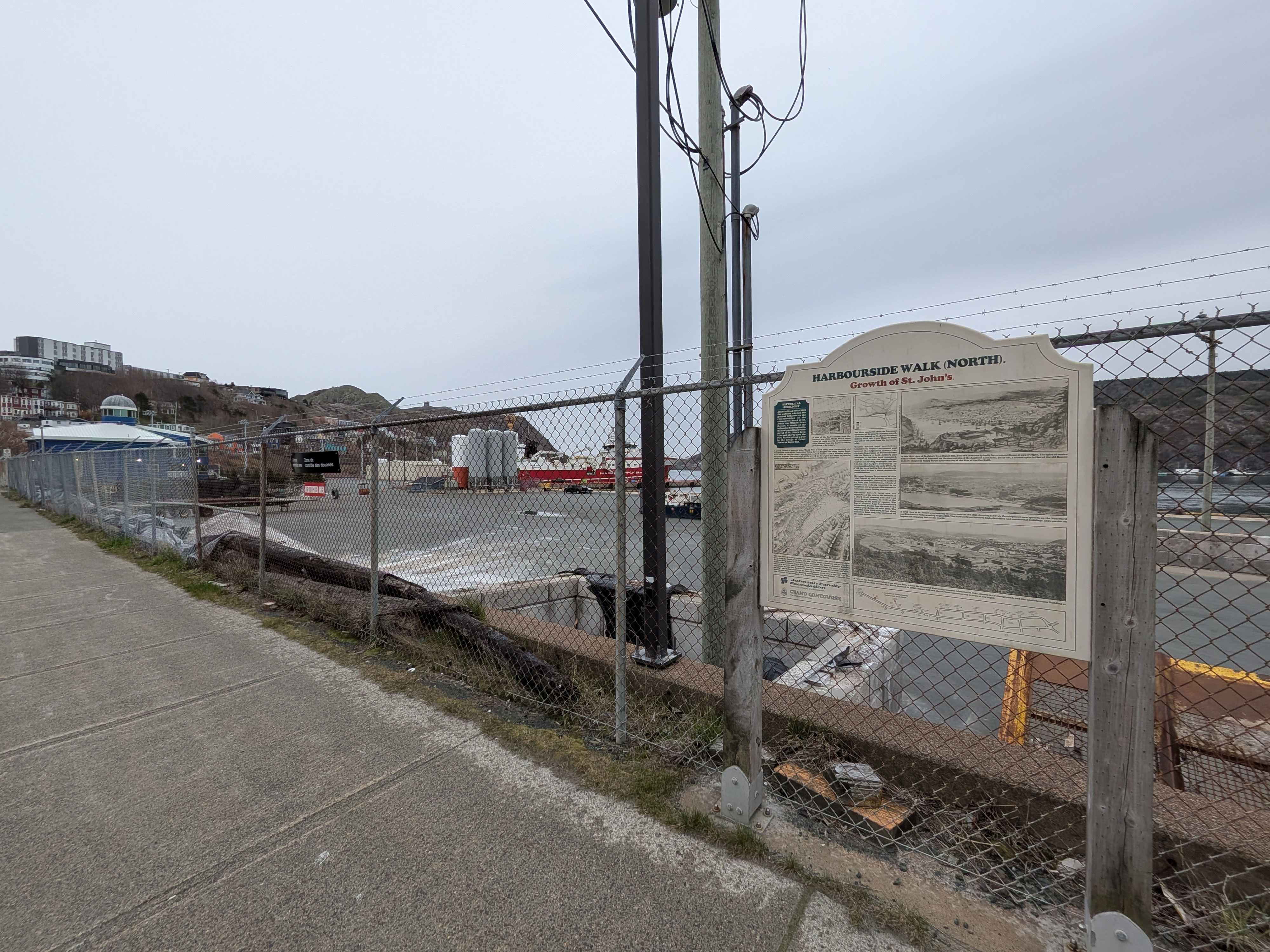
Photo: Andy Farnsworth
Inscription
HARBOURSIDE WALK (NORTH). Growth of St. John's.
HISTORICAL SIDELIGHT After the Great Fire of 1892 the architect who had the greatest influence on the reconstruction of the commercial heart of St. John's was William Howe Greene. A cousin of the influential Bowring family, the newly-qualified Greene moved to St. John's from Liverpool shortly after the Fire. He also played a role in the design of Cabot Tower, on Signal Hill.
For three centuries after the European discovery of St. John's harbour, growth of the settlement on its shores was slow. Indeed, until 1811 it was illegal to build more than 200 yards from the harbour's edge.
Despite British legal restrictions intended to restrict settlement and protect the migratory fishery, the strategic importance of Newfoundland and its fishery — both military and economic — had long been recognized. And St. John's was the unquestioned capital and trading metropole for the Island, the largest settlement in Newfoundland since the early 1700s. By 1728 the town had its first church, and there were at least a dozen mercantile establishments.
Governor Erasmus Gower noted in 1810: "the Capital of this Colony should no longer be cramped, cabined and confined by laws and restrictions, which at present are entirely unsuited to its condition and progress… this harbour is no longer a mere fishing station."
Governor Gower's term saw the expansion of the city by the addition of a third street running east and west (now Gower Street), as well as the founding of the first newspaper (The Royal Gazette And Newfoundland Advertiser). By this time the town had a winter population of nearly 4,000, with numerous lanes and paths scattered off the main streets.
A great period of growth after World War II saw many new residential and commercial areas in the Freshwater Valley, Cowan Heights and along Torbay Road. Soon after the War, St. John's population reached 50,000 — and it doubled within the next 25 years. However, much of the growth in the region has taken in place in Mount Pearl and other residential communities outside city boundaries.
A view of the harbourfront from the Battery, late 1930s. World War II began an era of rapid growth in the suburbs more distant from the harbour which gave birth to St. John's.
In this 1831 view of St. John's from Signal Hill, note the then newly-built Government House at upper right. The spire at centre is that of the Church of England, on the current site of the Anglican Cathedral. To its left, a second spire is that of the old Roman Catholic chapel on Henry Street (current site of the Star of the Sea Hall).
A 1998 view of St. John's overlooking the same area as the 1831 drawing (above). Development now spreads up the Waterford and Freshwater Valleys and up Nagles Hill. The harbourfront features high-rise office and commercial buildings, and remains an important shipping link to the world.
A view of the Freshwater Valley from Mount Scio, where the Memorial University campus relocated in 1961, shown in the foreground, and the Confederation Building at left (opened in 1960) and the West Block (opened in 1985). Signal Hill and the harbour entrance can be seen at top right.
This 1885 British Hydrographic Chart of St. John's shows the growth pattern of the town. Note the finger piers along this side of the bustling harbour and the Graving Dock and Long Bridge at the far end. Fort Townsend, the Basilica, Colonial Building and Government House can be picked out along Military Road. The city's population boomed in the early 1800s, buoyed by years of a prosperous fishery. By the end of the Napoleonic Wars in 1815 there were more than 10,000 people. Over the next century the city's population tripled, as St. John's began to creep "above the hill"… to The Barrens near the present-day Basilica, to Cookstown and the Higher Levels, and into "the country" along Portugal Cove, Topsail and Torbay Roads.
Locations of Historyboards Harbourside Walk North
Johnson Family Foundation Research, Design, and Installation GRAND CONCOURSE The Walker's Paradise
Commemorates 1700–1998