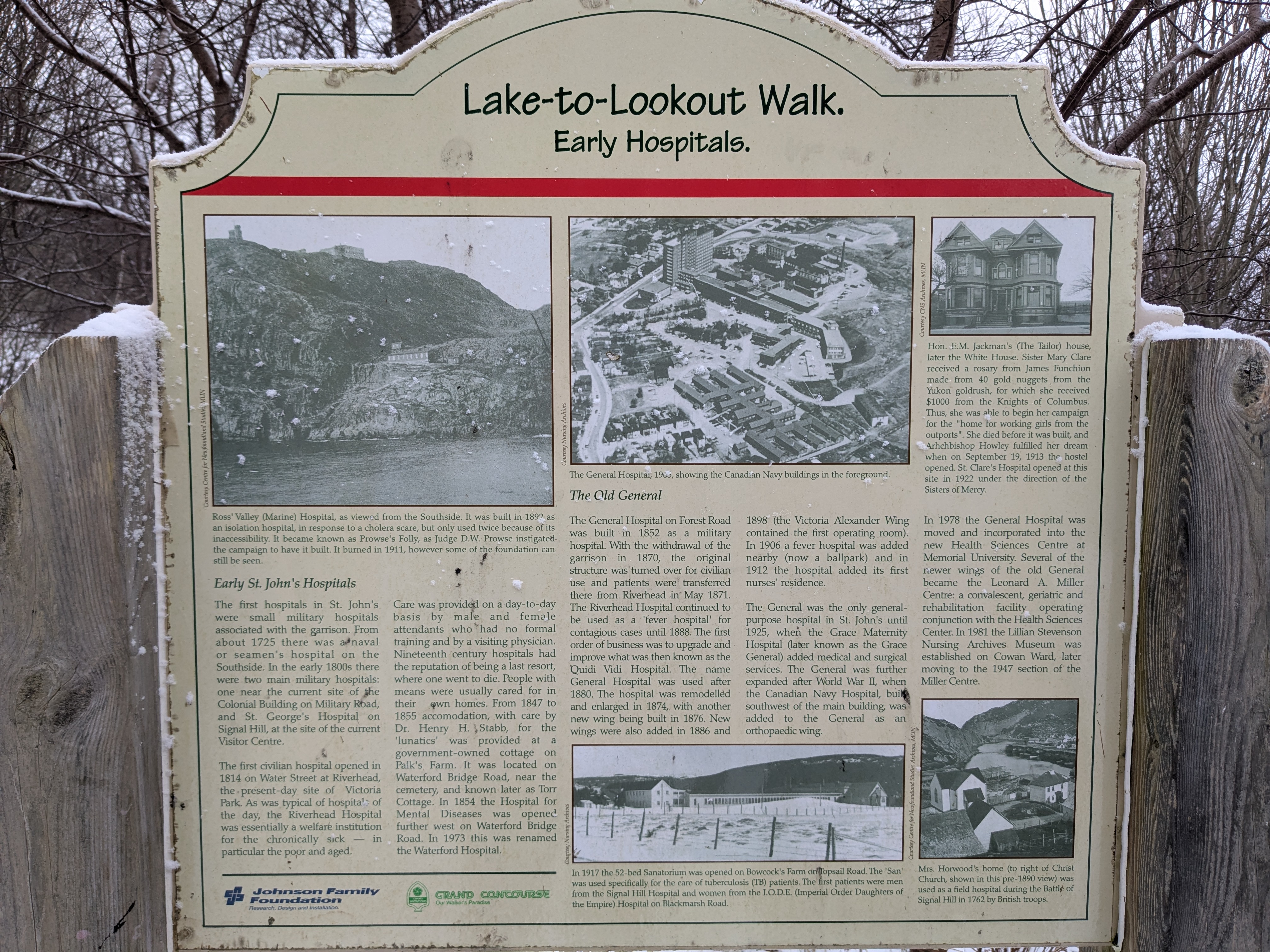
Lake-to-Lookout Walk info-board (Early Hospitals panel), winter view near Quidi Vidi
Photo: Andy Farnsworth
Inscription
Lake-to-Lookout Walk. Early Hospitals.
Early St. John's Hospitals
The first hospitals in St. John's were small military hospitals associated with the garrison. From about 1725 there was a naval or seamen's hospital on the Southside. In the early 1800s there were two main military hospitals: one near the current site of the Colonial Building on Military Road, and St. George's Hospital on Signal Hill, at the site of the current Visitor Centre.
The first civilian hospital opened in 1814 on Water Street at Riverhead, the present-day site of Victoria Park. As was typical of hospitals of the day, the Riverhead Hospital was essentially a welfare institution for the chronically sick — in particular the poor and aged. Care was provided on a day-to-day basis by male and female attendants who had no formal training and by a visiting physician. Nineteenth century hospitals had the reputation of being a last resort, where one went to die. People with means were usually cared for in their own homes. From 1847 to 1855 accommodation, with care by Dr. Henry H. Stabb, for the 'lunatics' was provided at a government-owned cottage on Palk's Farm. It was located on Waterford Bridge Road, near the cemetery, and known later as Tarr Cottage. In 1854 the Hospital for Mental Diseases was opened further west on Waterford Bridge Road. In 1973 this was renamed the Waterford Hospital.
The Old General
The General Hospital on Forest Road was built in 1852 as a military hospital. With the withdrawal of the British garrison in 1870, the original structure was turned over for civilian use, and patients were transferred there from Riverhead in May 1871.
The Riverhead Hospital continued to be used as a 'fever hospital' for contagious cases until 1898. The first order of business was to upgrade and improve what was then known as the General Hospital. The name was changed in 1874, with another wing added in 1876. New wings were added in 1886 and 1898 (the Victoria Alexander Wing contained the first operating room). In 1906 a fever hospital was added nearby (now a ballpark) and in 1912 the hospital added its first nurses' residence.
The General was the only general-purpose hospital in St. John's until 1925, when the Grace Maternity Hospital (later known as the Grace General) added medical and surgical services. The General was further expanded after World War II, when the Canadian Navy Hospital, built southwest of the main building, was added to the General as an orthopaedic wing.
In 1978 the General Hospital was moved and incorporated into the new Health Sciences Centre at Memorial University. Several of the newer wings of the old General became the Leonard A. Miller Centre: a convalescent, geriatric and rehabilitation facility operating in conjunction with the Health Sciences Center. In 1981 the Lillian Stevenson Nursing Archives Museum was established on Cowan Ward, later moving to the 1947 section of the Miller Centre.
Ross's Valley (Marine) Hospital, as viewed from the Southside. It was built in 1897 as an isolation hospital, in response to a cholera scare, but only used twice because of its inaccessibility. It became known as Prowse's Folly, as Judge D.W. Prowse instigated the campaign to have it built. It burned in 1911, however some of the foundation can still be seen.
Hon. E.M. Jackman's (The Tailor) house, later the White House. Sister Mary Claire received a rosary from James Junction made from 40 gold nuggets, for which she received $1000 from the Knights of Columbus. Thus, she was able to begin her campaign for the 'home for working girls from the outports'. She died before it was built, and Archbishop Howley fulfilled her dream when on September 19, 1913 the 'hostel' opened. St. Clare's Hospital opened at this site in 1922 under the direction of the Sisters of Mercy.
Mrs. Horwood's home (to right of Christ Church, shown in this pre-1890 view) was used as a field hospital during the Battle of Signal Hill in 1762 by British troops.
Johnson Family Foundation · Grand Concourse
Commemorates 1725–1981 · Johnson Family Foundation · Grand Concourse