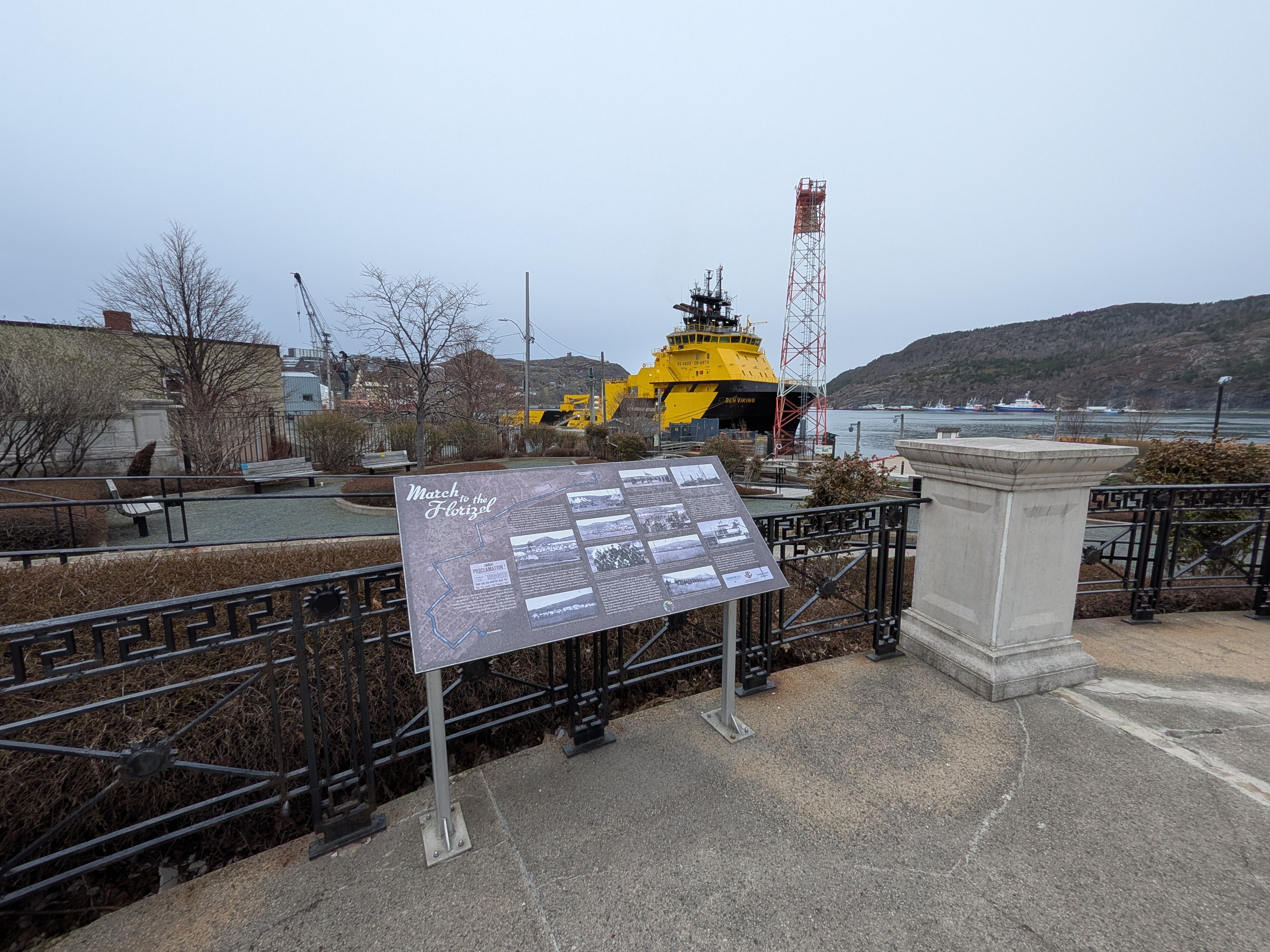
Photo: Andy Farnsworth
Inscription
March to the Florizel
The call for volunteers from Newfoundland was proclaimed by Governor Davidson on August 21st, on the advice of his Government. Newfoundlanders quickly answered the call to enlist and in numbers that did the then Dominion proud. Within days of the call for volunteers, the Newfoundland Patriotic Association had signed up 335 men, and by the end of September, 1914 that number grew to nearly 1,000. We were able to raise, train, and maintain a regiment in addition to the thousands of Newfoundlanders who served with our allies on land and at sea in answer to the King's call to arms.
PROCLAMATION!
Great Britain declared war against Germany on August 4th, 1914. The Newfoundland Patriotic Association was formed on August 12th and given responsibility by the Government, in the absence of a Department of Militia, for all recruiting, training and equipping the promised Newfoundland Regiment.
Training grounds were quickly set up at the then cricket field at Pleasantville, on the shores of Quidi Vidi Lake. Tents were donated by the Government, businesses and private citizens, and shelters were even made from sails donated by vessels in the harbour! By September 2nd the first recruits entered the camp and began their rigorous and compressed basic military training program before leaving to fight overseas for King and Country.
Governor and Lady Davidson, Prime Minister Morris and other politicians, and heads of churches and organizations were waiting at the pier to bid farewell and wish all "God-speed". Forever known as the 'Blue Puttees', the distinctive blue leggings became the First Five Hundred's badge of honour.
Originally a passenger and freight liner, the S.S. Florizel was one of the world's first steel-hulled icebreakers and used each spring in the seal hunt. The Florizel was commissioned to carry the Newfoundland Regiment to England. Conditions were overcrowded and improvised arrangements made to convert the vessel that had accommodations for 145 first class and 35 second class rooms into a troopship that now carried over 500 men.
Newspaper accounts of the day record the "largest gathering of citizens ever seen here assembled … to witness the embarking of the Newfoundland Regiment" — some estimated twenty-five thousand. "Thousands marched along … and many people assembled all along the line of march, and cheered the soldiers…." Closing early that day, businesses and stores, along with many private residences, were decked with flags and bunting along the parade route. Patriotic words of farewell and hearty cheers were shouted out to the passing men. Relatives and friends gave last-minute hugs, handshakes, and teary-eyed goodbyes.
The "First Five Hundred", about 540 strong, as they filed out of the training grounds at Pleasantville at 4:30 PM Saturday, October 3rd, 1914, and marched briskly and proudly in tight formation. They marched to the cadence of the Catholic Cadet Corps (CCC) Band, which guided them west along Quidi Vidi Lake (The Boulevard) over King's Bridge Road and onto Circular Road. Turning onto Bannerman Road and passing Government House grounds, they turned west once more onto Military Road. The long procession went down Prescott Street to Water Street. The S.S. Florizel, a recently converted troopship, was waiting at the Furness Withy Company pier, just east of Harbourside Park, known then as King's Beach.
At the dockside the Church Lads' Brigade, the Methodist Guards, and Salvation Army Bands each played lively patriotic and military tunes in turn to the cheers of tribute from the crowd. A final hymn was played when the Regiment had boarded and the Florizel cast off and steamed to the middle of the Harbour and, the next day, out through the Narrows.
The Newfoundland Regiment training camp at Pleasantville. Quidi Vidi Lake is in the background.
A lunch break for the volunteers during their training at Pleasantville. There were ten tents to each Company and ten men in each.
Bayonet exercises at Pleasantville. Note the rifles do not have bayonets attached. The volunteers are wearing their Regiment issued khaki pants and blue puttees, yet also civilian hats.
The Medical Unit of the First Newfoundland Regiment at Pleasantville. All held St. John Ambulance Certificates. Dr. Cluny Macpherson (back, fourth from left, in St. John Ambulance Brigade uniform) and local doctors performed the medical examinations which all recruits had to pass before training could commence.
Another view of the training camp at Pleasantville. The White Hills are in the background.
The Regiment is shown in formation, wearing their Regimental issued greatcoats and civilian caps, with first kit bags on the ground at Pleasantville — ready to March to the Florizel.
Large numbers of citizens went to Pleasantville on foot, in horse-drawn carriages or carts, and automobiles to see the Newfoundland Regiment off.
In formation wearing their Regimental issued greatcoats without headdress, at the training grounds at Pleasantville. The Regiment's slough-style hats had not arrived in time for their departure, civilian caps were worn by those that had one.
Governor Sir W.E. Davidson presenting a specially inscribed Union Jack to the Newfoundland Regiment. Kneeling to accept the flag is Lieutenant Holland Tait. Prime Minister E.P. Morris (in the light grey coat and bowler hat) is watching at right.
The men of the first contingent of the Newfoundland Regiment line the rails of the S.S. Florizel, which departed St. John's harbour on October 4th, 1914.
HONOUR 100 FIRST WORLD WAR COMMEMORATION NEWFOUNDLAND AND LABRADOR
Royal Newfoundland Regiment Advisory Council
Newfoundland Labrador
Commemorates 1914