Photo: Andy Farnsworth
Inscription
Military-Rennie's-Circular-King's Bridge. Military Road. Colonial Building. Bannerman Park.
Military Road
Military Road was laid out in 1773 by the chief engineer of the garrison, Lt. Robert Pringle, in order to connect Fort William to Fort Townshend (which was then under construction). Part of a master plan to improve the defences of St. Johns, the new road traversed a ridge above the town, intersecting with the new King's Road at what is now Rawlins Cross. To the north of Military Road there was a common, known simply as "the Barrens".
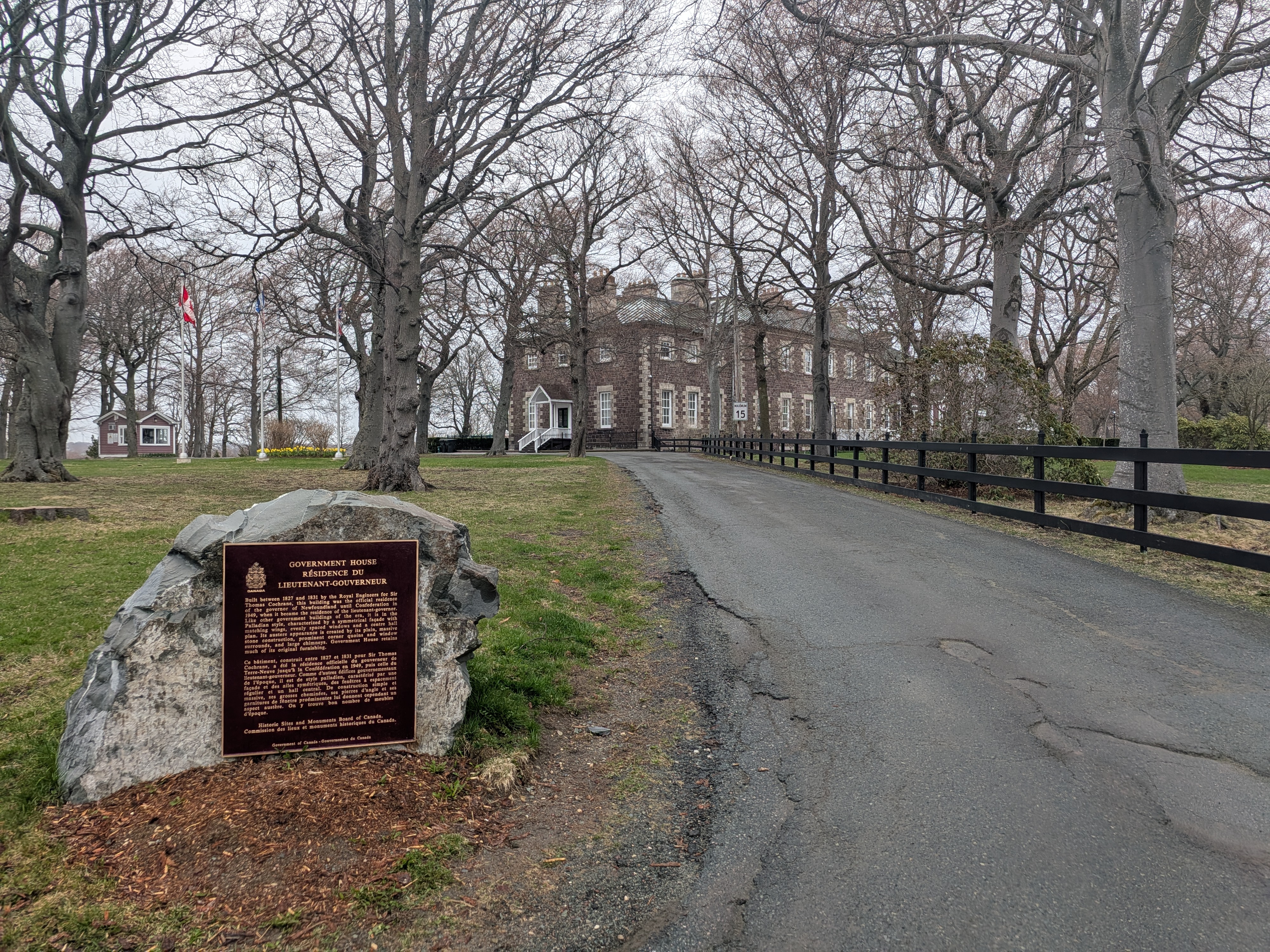
Although remote, Military Road had the advantage of being removed from the fish flakes crowding the harbour and was chosen in 1827 by Governor Sir Thomas Cochrane as the site for Government House. Nearby, St. Thomas' Church was completed by builder Patrick Kough in 1836. By 1841 work had begun on the construction of a stone Roman Catholic church at the other end of Military Road, the Cathedral (now Basilica) of St. John the Baptist. Prescott Street was built in the early 1840s, by which time a small residential neighbourhood (known as Turbid Town) existed near Rawlins Cross.
Bannerman Park
After the Great Fire of 1846 many merchants decided to build their homes 'above the Hill'. The proximity to the new Legislature added to the appeal of the neighbourhood for the upper class. In 1847 the Botanical Garden, complete with a hothouse, was opened to the public on land donated by two citizens, but soon proved insufficient in size. The adjoining undeveloped land was earmarked for a public parkland by Governor Sir Alexander Bannerman in 1864. It soon became known as Bannerman Park. It was twice used as temporary housing for citizens after fire ravaged the town in 1846 and again in 1892. In 1846 an added sadness happened when the Natives' Society's hall (next to the hothouse) was blown down, killing a five year old boy and his older sister who had sought shelter there. Rinks for curling and skating, the Victoria and Avalon, were also built here, but both were destroyed by fire in 1878. Further development or landscaping did not occur until it received funding from the first municipal council in 1888. The Park had been used as a social gathering place with the garrison band performing on Tuesday afternoons and later the council hired bands to entertain. The Park was officially opened in September 1891.
The Colonial Building
The Newfoundland Legislature met from 1833 to 1846 in the old Court House on Duckworth Street. Plans for a permanent legislative building originally focussed on the downtown area, but Public Buildings Superintendent Patrick Kough recommended this present site as better suited to architect James Purcell's design. The destruction of the downtown by the Great Fire of 1846 sealed the decision. Construction began in 1847 under the direction of Kough and Purcell, who had been working together on the Roman Catholic Cathedral. Purcell's design included a limestone facing, quarried in his native Cork, Ireland. The building was opened in 1850 and later that same year the Savings Bank, housed in the basement, fell victim to the first bank robbery in Newfoundland's history. The sum of £413 was stolen.
Colonial Building was outlined in lights to celebrate the Silver Jubilee of King George V in 1935. During the 50th Anniversary of Confederation celebrations in 1999, it was once again outlined in white lights at Christmastime.
The Colonial Building has seen many of the pivotal events of Newfoundland history, including the establishment of Responsible Government in 1855 and an infamous riot in 1932 when a 3,500-person strong mob did $10,000 worth of damage and which contributed to the decision to accept a suspension of Responsible Government in 1934. The sessions of the National Convention (1946-1948) were held here to decide upon Newfoundland's future: return to Responsible Government, continue with Commission of Government, or Confederation with Canada. The new province's elected House of Assembly sat here from 1949 until Confederation Building was opened and the Legislature was moved there in 1959. Since 1960 it has been home to the Provincial Archives of Newfoundland and Labrador. In December 1999 it was announced that the Provincial Archives would move to the cultural building at Fort Townshend, The Rooms, while preserving the Colonial Building as an important heritage structure.
Commemorates 1773–1999