Photo: Andy Farnsworth
Inscription
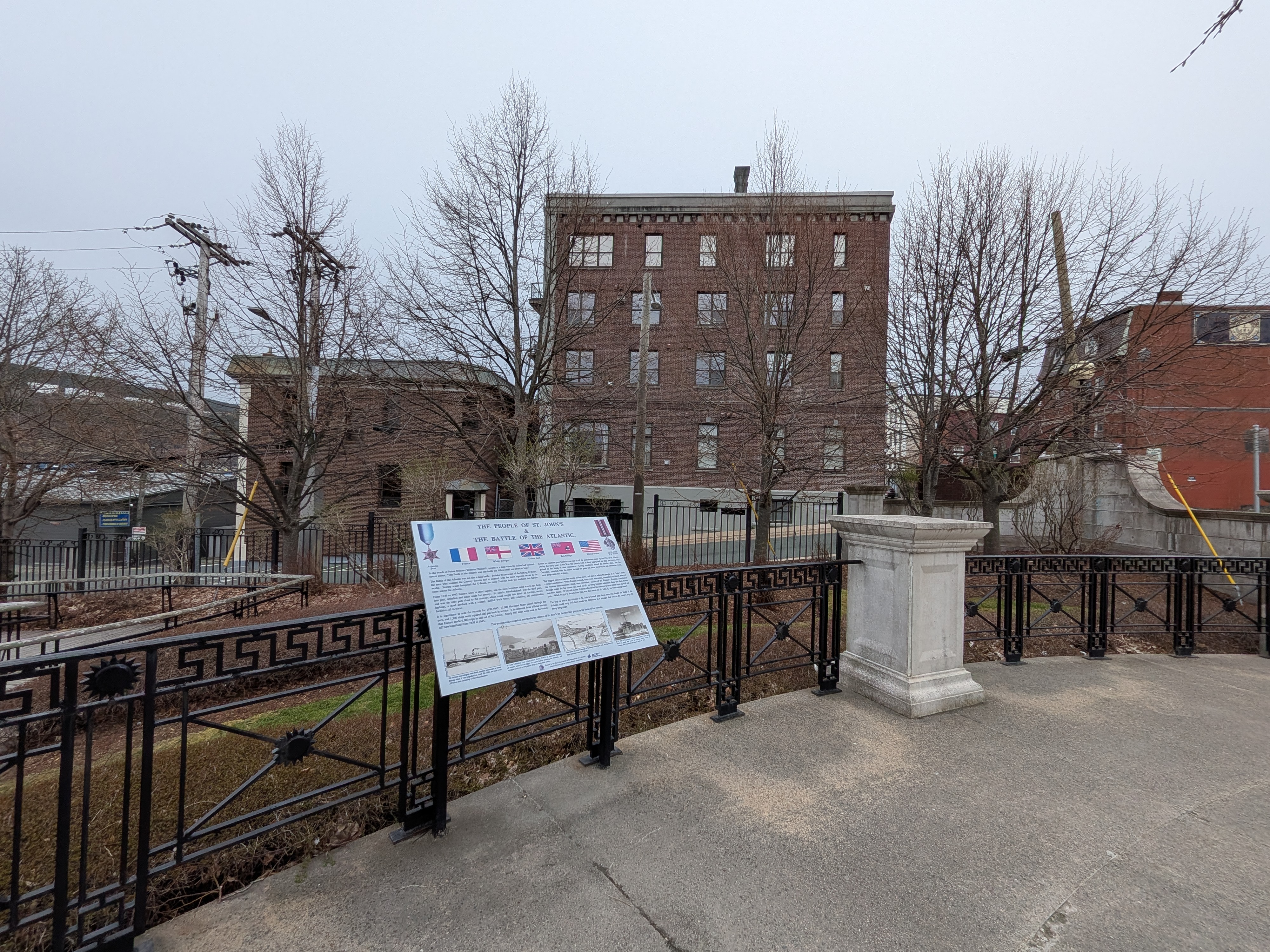
THE PEOPLE OF ST. JOHN'S & THE BATTLE OF THE ATLANTIC.
Atlantic Star France White Ensign Union Jack Red Ensign United States 1939-1945 War Medal
In the words of Prime Minister Winston Churchill, spoken at a time when the Allies had suffered severe losses, "The Battle of the Atlantic was one battle the Allies could not afford to lose."
The Battle of the Atlantic was not like a land battle. Besides the presence of the lurking U-Boats, the men who manned the Convoy Escorts had to contend with the most rigorous ocean in the world. Stormy water hampered the U-Boats, so most Convoys took the northern but harsher route across the Atlantic.
From 1939 to 1942 Escorts were in short supply, and the most important need was to get them into port, refuelled and made ready for convoy. St. John's, Newfoundland, was the ideal port, and was the only port close to the convoys which could supply this need: an ice-free, secure harbour, a good drydock with a trained, skillful work force, and refuelling and provisioning facilities, all in place.
Access to excellent port facilities was not all of the contribution made by the City of St. John's. During the early years of the War, the Escorts were in short supply and the ships and crews were pushed to the limits of their endurance. Living conditions aboard the smaller ships, like the Corvettes, crowded with the crews to man the guns and those involved in anti-submarine work, were desperately bad at times.
The biggest concern was the morale of the crews, and here is where the people of St. John's made a great contribution. When Escorts arrived, there were welcoming committees to inform them of the various entertainments which were provided. Ladies of the Women's Patriotic Association brought cakes for the crews, and most of all, so many families welcomed them into their homes and their hearts. If you talk to any Veteran who sailed the convoys in those bitter days, he will tell you, "When we got to Newfy John [this was their name for St. John's], we were coming home".
The way in which the citizens of St. John's looked after those men who fought the Battle of the Atlantic could very well have made the difference in a struggle that was on the razor's edge for many long years.
It is significant to note the records for 1939-1945: 10,000 Merchant Ships passed through this port, and 1,300 ships were repaired and put back in service. It is estimated from official sources that Escorts made 6,000 trips in and out of St. John's. Nearly 400 ships were sunk in the waters off Newfoundland from 1939 to 1945.
This presentation recognizes and thanks the citizens of St. John's for the part they played in the Battle of the Atlantic.
SS Nerissa was bringing vital food, supplies and troops to Great Britain when it was torpedoed on April 30, 1941 and sank with 207 lives lost, including 14 Newfoundlanders.
St. John's Harbour was a busy place during WWII, as countless numbers of vessels came for re-supply or repair before crossing the Atlantic, and brought survivors of torpedoed ships to welcomed safety.
This shows the artist's concept of Corvettes returning to port, having escorted ships mid-way across the Atlantic.
J272, HMCS Esquimalt, a Navy Minesweeper, used during WWII to guard and escort the convoys safely across the Atlantic, until torpedoed and sank on April 16, 1945.
Erected by the Naval Association of Newfoundland and Labrador, ~ Eastern Division and the Johnson Family Foundation
Johnson Family Foundation
Commemorates 1939–1945