Photo: Andy Farnsworth
Inscription
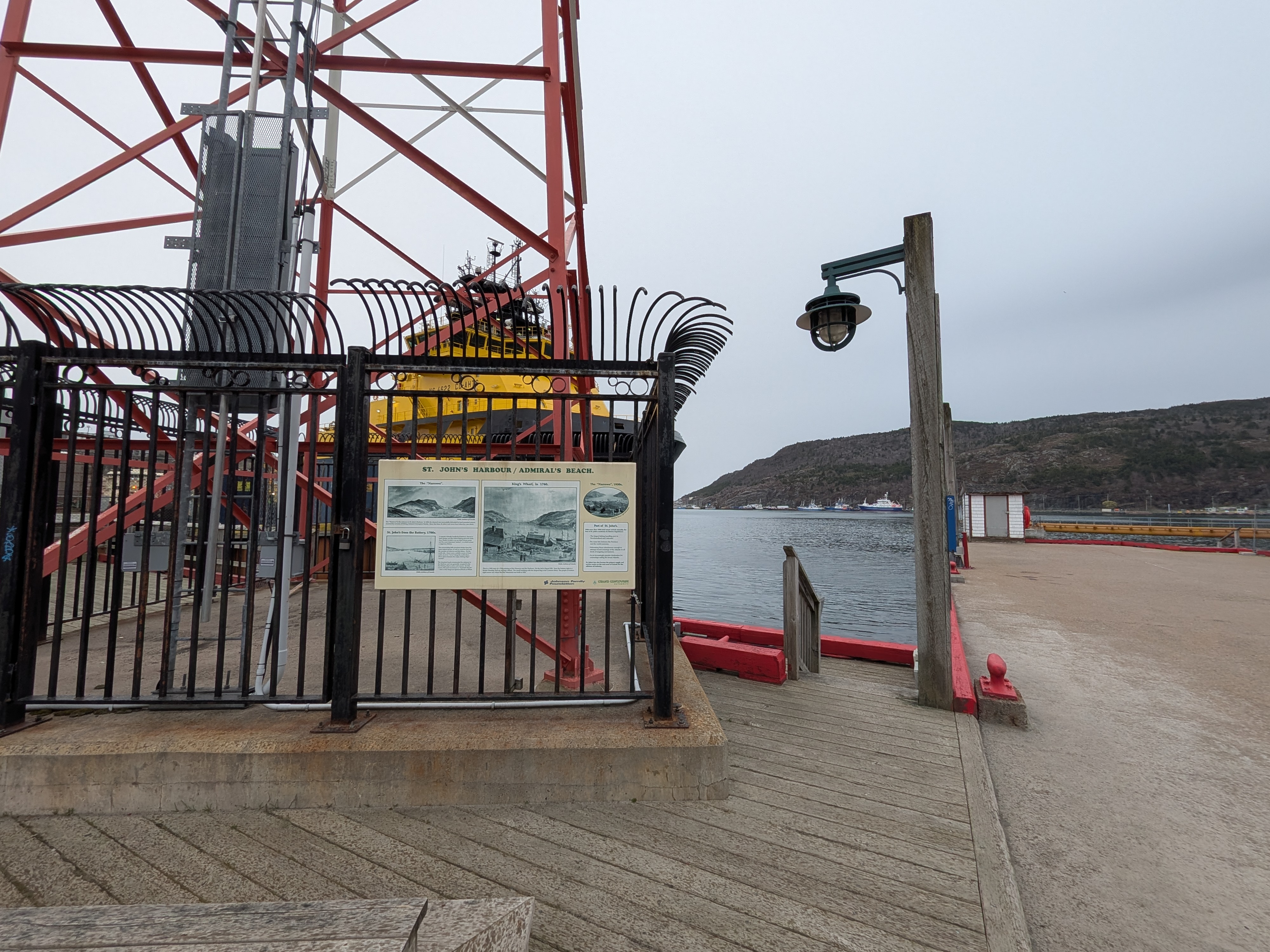
ST. JOHN'S HARBOUR / ADMIRAL'S BEACH.
The "Narrows".
The "Narrows" is the entrance to St. John's Harbour. In 1655, the channel was successfully defended by land-mounted cannon manned by servants of Fishing Admiral Christopher Martin. Since that time, St. John's had never been taken by a sea attack.
St. John's from the Battery, 1700s.
A natural, virtually landlocked Harbour, closest to both Europe and the richest fishing grounds of the New World, St. John's was an ideal convoy point and the most important "station", in which to base a migratory fishery.
The surrounding hills provided shelter from the most violent storms, as well as wood for fuel and the erection of wharves and fish flakes. On the north side, rivers were a reliable source of fresh water, at seven "coves" along the north shore. These places became the major, fishing ships' "rooms".
The broadest beach commanded the entrance to the Harbour and was generally occupied by the first fishing ship to arrive each season. For this reason, this spot was known as "Admiral's Beach" - - later as the King's (or Queen's) Beach or Wharf.
King's Wharf, in 1760.
This is a 1902 copy of a 1760 painting of the Narrows and the Harbour. On the left is Signal Hill. Near the bottom right is a British Warship, tied up at King's Wharf. The small building with the draped flag is the Customs Shed. The people at bottom right corner are where the War Memorial was built in 1923.
The "Narrows", 1900s.
Courtesy Harry Cuff Publications
Port of St. John's.
With more than 1000 total vessel arrivals annually, the Port of St. John's continues its historic importance:
- The largest fishing-handling port in Newfoundland and Labrador.
- The main link between the Province and the world economy.
- Welcoming those adventurous enough to attempt record crossings of the Atlantic in all kinds of seagoing conveyances.
- As an increasingly popular destination for cruiseships sailing the broad Atlantic.
St. John's has also become the primary supply and service centre on the east coast of Canada for the offshore oil industry.
Public Archives of Canada
Johnson Family Foundation
GRAND CONCOURSE AUTHORITY
Commemorates 1655